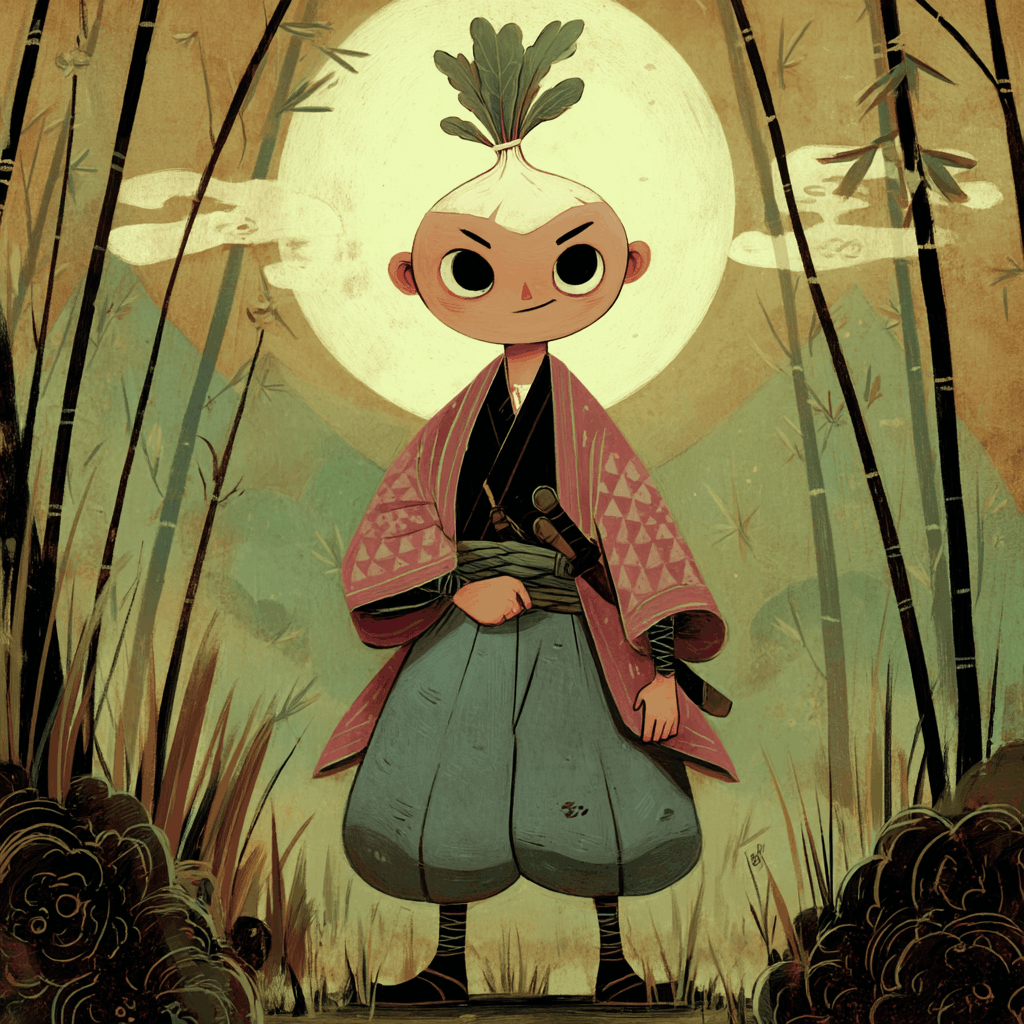
Kabu
A fifteen-year-old who's read too many folk hero stories and not enough about what they actually cost.
What they want
To find every seed the crows scattered and bring them home, lifting the curse on Furumi and on his own head. He treats the journey like one of the adventures from his scrolls. It's also penance, since he's the one who broke the witch's rule.
What they need
To learn that the world doesn't sort into heroes and villains. He needs it to sort that way: if demons are simply evil, then killing them makes him a hero, and the curse becomes the start of his legend instead of his biggest mistake. The season keeps handing him demons that used to be people.
Voice
Says what he's thinking, which reads as charm until you know him well enough to notice he gets louder when he's wrong. Never says he doesn't know something, just says he has a plan instead.
The arc
Kabu grew up in Furumi reading folk heroes and waiting for his chance to be one. When the crops fail, his father tells him to stay put and ration with everyone else. He goes into the foothills instead, taking Kabocha with him, and comes back from the witch's hut with a golden sunflower that feeds the whole village: one seed per person each morning, eaten on the spot, any unclaimed seed thrown away by sundown. For four days he's a hero. He's also quietly keeping the unclaimed seeds in a jar whenever a family is away, because throwing out perfect food feels wrong and the flower might fail one morning. On the fifth day a girl asks him for a second seed. Nobody in Furumi is hungry anymore; it's just the best thing she's ever tasted, and everyone knows Kabu keeps spares. He gives her one. He doesn't agonize over it. Given the choice between a rule and a person he can see, Kabu picks the person. That night the crows come, the seeds scatter across the country carrying the villagers' worst qualities with them, and the curse takes Kabu alone: a turnip for a head, and no explanation for why only him. He picks up his father's scythe and leaves to collect what he scattered.
He's not much of a fighter at first. He swings the scythe like someone who's read about fighting more than done it, misses a lot, and gets back up every time. What carries him through the early episodes is confidence the results don't justify: he leaves Mazekane singing about how easy this all is, then nearly gets a village buried in bamboo because he charged in past a local kid's warning. In episode four, Matsu asks whether they actually did the right thing that day. Kabu doesn't answer. In episode five, a manipulator worms her way into his ear and turns him against Kabocha, and at his lowest point he beats her by offering friendship instead of a fight. "You don't need to corrupt people to be friends. I'll be your friend." It works. Her power breaks. Two episodes later he tells Momotaro, with total conviction, that demons should be killed. "Have you ever killed one?" "No. But I would." Nobody points out that his best win so far came from mercy, and Kabu doesn't notice it himself.
His other habit is dodging hard conversations. Kabocha spends the season trying to get him to deal with the team's own problems, and his answer is always that they'll talk later. In episode eight he shows he can do it, pushing Lord Hiroaki through the honest confrontation that saves him. He just never turns the same skill on his own camp. Episode nine collects on that. At the Tanabata festival, Ume turns down the crush he's been carrying since Mazekane, and when he asks if it's the turnip head, she says she loves the turnip head, and he takes the real answer without arguing. Hours later, Kabocha detonates mid-battle, tells him he never listens, and walks off the team with a cursed splinter in her palm. They never did talk.
The finale tests both threads. In Furumi, Kabocha ambushes the team with everything she knows about their weaknesses, and Kabu refuses to fight her. He talks to her instead, tells her she's his best friend, and it reaches her where nothing else does. Then on Mount Madarao he faces the last demon of the season, an ancient Tengu who trades a few blows, studies him, and accepts the killing stroke. Kabu delivers it, because demons should be killed. The victory feels wrong and he can't say why. His core belief is broken, and he ends the season more uncertain rather than wiser, which is actually further along than it sounds.
Relationships
Kabocha
The structure he's never had to build for himself. She plans and he doesn't, a dynamic she's been managing since they were small: her structure contains his impulses, his momentum stops her from planning past the moment. What neither of them accounts for is that the season is going to close that gap, and as Kabu grows into someone who needs the structure less, Kabocha reads it as the team needing her less, which is the thing the Crow Witch eventually finds and uses.
Matsu
Everything the folk hero template says a hero should look like, which Kabu initially treats as a competition. By the end of the season they've quietly traded something: Kabu learns to sit with discomfort instead of talking through it, Matsu learns that sitting with something too long sometimes means the moment goes past. Kabu is also the one who started calling him Pinecone, which Matsu corrects every single time and has stopped actually minding.
Ume
Both excited by the world but about completely different parts of it: she wants to know why something is happening, he wants to know what his role is. She was the first person to treat his turnip head as something interesting rather than something to be polite about, back when he couldn't laugh about it yet. The crush he carried from Mazekane ends at the Tanabata festival with a clear, kind no. He takes it better than anyone expected, himself included.
Momotaro
The rivalry runs one direction. Kabu grew up singing about Momotaro, then met a boy wearing the legend's name, carrying the same kind of curse, and completely at peace with it. He competes for most of an episode with someone who doesn't know there's a competition. What finally earns Momotaro's respect is the confession Kabu makes when he stops competing: that he did to Furumi what Momotaro is about to do to his own rice fields. Kabu leaves Aokusa with a gifted chain-scythe and the itch of having been out-heroed by someone he can't even dislike properly.
Songs by Kabu
6 songs across the season
Call of Adventure
Kids vocals, orchestral score
06 · Episode 3First One Down!
animated musical, kids voices, playful duet, quick-paced, conversational, comedic, back-and-forth banter, catchy chorus, dynamic energy
09 · Episode 5One Bad Apple
Kids vocals, orchestral score
12 · Episode 6A Taste of Rivalry
animated musical, ensemble cast, playful, upbeat, theatrical, comedic, storytelling, orchestral, lively percussion, plucked strings, dynamic energy, whimsical, lighthearted, rhythmic, cinematic
13 · Episode 7What It Takes to Be a Hero
orchestral score, musical theater, pop
22 · Episode 11Echoes of Adventure
Acoustic cover, kids vocals, reflective, cinematic, emotional journey, energetic finale, heartfelt, uplifting anthem, triumphant, playful crescendo, joyous transformation, dynamic build
Episodes Featuring Kabu
12 episodes across the season
The Seeds of Mischief
Furumi · Nagano Prefecture
A Harvest of Hubris
Mazekane · Kanazawa
The Bamboo that Bends
Shugoro · Himeji
The Steep Price of Tea
Cha-Obe · Kobe
Cut to the Core
Usokashi · Aomori Prefecture
Battle of the Bowls
Menpaku · Morioka
The Cost of Comparison
Aokusa · Okayama Prefecture
Beneath the Painted Smile
Futamen · Fukuoka / Hakata
Star-Crossed and Sideways
Aiseki · Sendai
The Fire Beneath the Lake
Shinkami · Hakone
The Fruit of Old Truths
Furumi · Nagano Prefecture — the journey full circle
Those Who Know Cannot Return
Mount Madarao · Mt. Madarao