真太楼
EPISODE 12

Those Who Know Cannot Return

One last mountain, one willing sacrifice, and the friend who's been feeding on all of it.

Town
Mount Madarao真太楼
真 (ma) — "truth" · 太 (ta) — "great; vast" · 楼 (rao) — "watchtower; tall building" — "The Great Tower of Truth"
Drawn From
Mt. Madarao, Nagano Prefecture — Sangaku Shinko (mountain worship)
Cursed Seed
The last seed / all souls collected
Item Gained
The Last Seed — the original golden sunflower kernel held by Madarao since the curse began. Returning it to Furumi's soil should break the vegetable-head curse. But Kinoko's hunger makes the ending uncertain.
The blurred line between allies and adversaries. Unintended consequences of seemingly heroic actions.
The Story

The team ascends Mount Madarao. Kinoko accompanies them but weakens with each step, asking to be left behind partway up. At the summit, they face Madarao — a shriveled ancient Tengu of immense power. The battle is fierce. Madarao accepts his defeat, trusting the heroes to maintain cosmic balance — a willing surrender. Kabu delivers the final blow. But the victory feels wrong. The team descends to find Kinoko eagerly awaiting news. As Kinoko talks, plants around him die. He siphons life from them. The heroes realize they may have freed the real villain all along. Cliffhanger.

The Shape of the Episode6 BEATS · CRISIS AT 6
TURNTURNCRISIS
OPEN THE BEAT SHEET
  1. 1The team ascends Mount Madarao. Kinoko accompanies them, weakening with each step, asking to be left behind.
  2. 2At the summit, they face Madarao — ancient, shriveled, terrifyingly powerful.
  3. 3The battle is fierce. Madarao, impossibly, begins to accept his defeat.
  4. 4TURNING POINT — Kabu delivers the final blow. Madarao falls. Something about the victory feels deeply wrong.
  5. 5TURNING POINT — The team descends to find Kinoko waiting eagerly. As he speaks, every plant around him dies.
  6. 6CRISIS — They watch him siphon life. The heroes realize they may have freed the real villain all along. Cliffhanger.
Season Threads
Kinoko's true nature is revealed at last, the payoff of a question Ume first asked out loud back in episode six and never got answered.UME · KINOKO
Madarao's willing surrender echoes Saru's in episode seven, and this time Kabu has had a whole season to learn what a surrender like that actually costs.KABU · MADARAO
The season ends on a cliffhanger instead of a resolution: the seed they just planted may have freed something worse than what they defeated.KABU
SONGS THIS EPISODETRACKS 23 · 24 OF THE SEASON
Every episode is a real musical — two originals, written before the storyboards.
23"No One Talks About the Ending"
UmeORCHESTRAL SCOREEMOTIONALLY RICHPRINCESS BALLAD

The season finale song. Ume's quiet reckoning with what heroism actually leaves behind. Draws on real Japanese folklore heroes — Tawara Tōda and Kintarō — to ask what comes after the legend ends.

–:–– / –:––
FULL LYRICS
[Verse 1] No one talks about the ending Not the scrolls or bedtime songs. They stop before the quiet feeling, Before you wonder what went wrong. [Pre-Chorus] They speak of blades and glory days, Of monsters slain and skies set right. But not the days that follow after, Or how to face a sleepless night. [Chorus] So what comes after the mountain climb? When the story ends but we still have time. When the hero wins, but there's no song… Were we just wandering all along? And if we don't know what comes after… At least we know we went together. [Verse 2] Tawara Tōda saved the dragons, Earned their thanks, then walked away. Did he miss the songs of tide and scale, Back in the peace of the everyday? [Pre-Chorus] Kintarō wrestled bears with ease, The Strongest that the tales recall. But did he lie awake some nights, And wonder if that strength was all? [Chorus] So what comes after the final page? A quiet heart, an empty stage. Was this the ending we were told? Was this the song they sang of old? And if we don't know what comes after… At least we know we went together. [Bridge] We climbed the peak, we fought the storm We stood in fire and came out warm But no one's here to cheer or cry Just clouds behind, and questions why. [Verse 3] We gathered seeds. We climbed the peak. We faced and won the final trial. We thought that if we paid the price, We'd reach the end of the extra mile. [Pre-Chorus] But the blight still spreads, the witch is gone And what is there to show instead? Returning home with our own tales, A bag of seeds, a turnip head. [Chorus] What comes after the fight is done? When the flags don't wave and the crowd doesn't come? If there's no one to cheer, no tale to be spun... Did we do it wrong? Or was there never one? [Final Chorus] So what comes after? Maybe just this: A bruise where the dream used to sit. But we walked the path. We bore the flame. We held each other when no one else came. Maybe there's no "ever after," after all is said and done— It's just the friends we choose to keep, and a little voice that says "go on."
24"The Forest Has Ears (Reprise)"
KinokoVILLAIN SONGELDERLY BARITONE VOICEMINOR KEY

The third and final version of Kinoko's signature song. No comedy, no warmth. The mushroom network was never a metaphor for community. It was always a map of everything he planned to take.

–:–– / –:––
FULL LYRICS
[Verse] Oh, travelers, didn't you know? The forest listens to everywhere you go. You thought it was your friend, your guiding light, But now it hunts you, you're in my line of sight. You trusted the whispers, followed every sign, But the forest has ears… and those ears are mine. [Chorus — Dark and Sinister] The forest has ears, it's got eyes in the trees, It'll track you down with the greatest of ease. There's no escape, no running free, I'll find you, wherever you might be. Oh, the forest has ears, and it listens close, Every step you take is a step I'll know. [Bridge — Final Threat] Run if you want, but you can't disappear, The forest surrounds you, I'm always near. The paths you once trusted are now just a snare, You're caught in the roots, I'm already there. [Chorus — Big and Dark] The forest has ears, it's got eyes in the trees, It'll track you down with the greatest of ease. There's no escape, no running free, I'll find you, wherever you might be. Oh, the forest has ears, and it listens close, Every step you take is a step I'll know.
SUPPORTING CASTMadarao · Kinoko (true form revealed)
Madarao
ROLEMountain Tengu / Season's final boss / Willing sacrifice
WANTSProtect the cosmic balance — and test whether a mortal hero is worthy of the responsibility he's about to inherit
FLAWHas held power so long he's forgotten how to trust; his willing defeat is the most courageous thing he's done in centuries
Kinoko (true form revealed)
ROLESecret villain / Soul-energy parasite
WANTSDrain Madarao's defeat to seize power over the Tengu Council
FLAWCannot help but reveal himself — after centuries of patience, the hunger overtakes the patience
The Real Japan
Mt. Madarao, Nagano Prefecture — Sangaku Shinko (mountain worship)

In Japan, Sangaku Shinko (mountain worship) holds that mountains are not locations but entities — living thresholds between the human world and the divine. Mt. Madarao, like many Nagano peaks, was historically understood as the home of Tengu: proud, ancient mountain spirits capable of teaching swordsmanship, navigating the divine bureaucracy, and punishing those who disrespect their domain. Tengu exist on a spectrum from lowly crow-tengu to great mountain lords — the hierarchy is strict, ancient, and deeply political. The Tengu isn't a monster infesting the mountain; he IS the mountain's voice and its oldest legal authority. The real Mt. Madarao is a mid-range ski resort in Nagano's Iiyama region. We chose to honor what it was before the chairlifts.
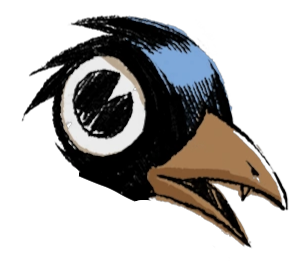
The Crow
The Crow Knows

Madarao (真太楼 — The Great Tower of Truth) sits at the top of everything the season built. A Tengu who has held power so long he no longer remembers what he was protecting. A mountain that became its own watchtower. The kanji say it clearly: great truth, seen from above, by something very old and very still. We put the final confrontation here because Nagano mountains are where Tengu live in the folklore, and because every great journey in Japanese mythology ends by going up. The chairlifts are not canon.