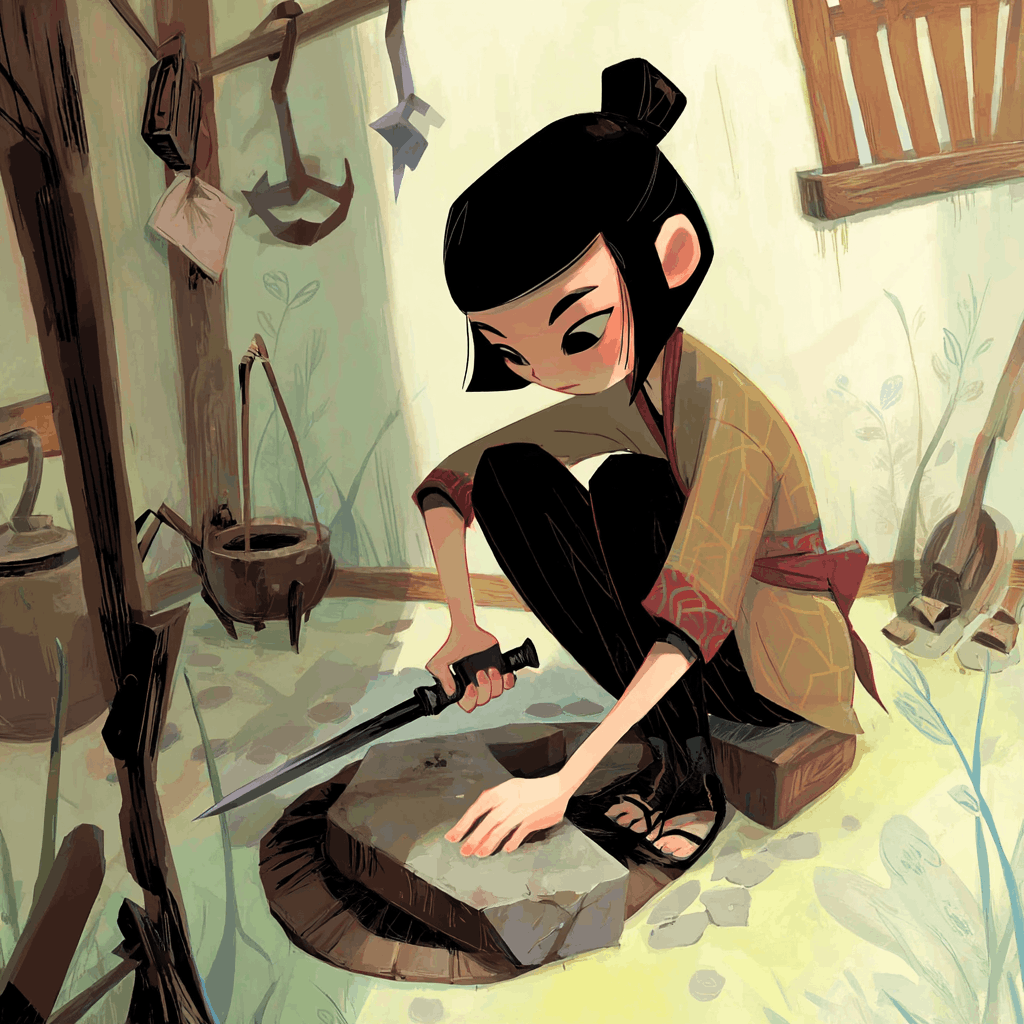
Kabocha
A sixteen-year-old who has been proving herself since she was old enough to pick up a weapon, but still doesn't feel like she has.
What they want
To be more than the girl who stayed in Furumi. Two of her three brothers have left for the world; she's the one who would have to stay and run her father's blacksmith. Coming on this adventure is about proving she's capable of more.
What they need
To feel like enough without needing it confirmed. The team owes most of their early wins to her, and none of it settles her anxiety underneath.
Voice
The loudest voice in the room when a plan comes together, and just as precise when she's giving Kabu a hard time about his height. Gets annoyed fast and forgives just as fast.
The arc
Kabocha grew up in her father's forge, sparring between chores and selling kunai to the adventurers passing through Furumi, and she treats every problem like something that yields if you're precise enough about it. When Kabu loses his head to the curse in episode one, she's the first one standing beside him to undo it, and what she brings to the team is exactly that precision: plans turned into action, and the loudest celebration in the room when one comes together. In Shugoro she directs a village through a crisis nobody had time to brief them on, rigging traps out of washing lines and back alleys the same afternoon, and it works. The team owes most of its early wins to her. The cursed seed splinter that embeds itself in her palm in episode two stays quiet for a long time.
Her confidence is fuelled by a fear of failure that was there long before the seed arrived. She grew up with a father who held his high standards just out of reach as a matter of principle, so the habit of measuring the gap between what she does and what gets noticed is older than the splinter by years. In Morioka she watches a father like hers finally say out loud that he pushed his children because he believed in them, and she tells her noodle mentor things she's never said at home. It helps less than it should. As the team grows more capable around her, she can't celebrate it the way a friend is supposed to; every skill they learn without her reads as her own contribution going invisible. Episode nine breaks it twice in one day. At a tea ceremony, Matsu tells a room full of people he'd marry someone like her, and the words won't come, so she leaves. That night, mid-battle, the anger she's been packing down all season goes off at Kabu, and she walks away from the team with the splinter flashing in her hand.
The Crow Witch finds her alone on the road with an argument that agrees with everything she's been feeling: the team's victories came from her unseen work, and she has every right to resent going unrecognized. What Kabocha doesn't grasp is that she's accepting a narrative handed to her rather than discovering one of her own.
At the breaking point in episode eleven she ambushes the team in Furumi, using every weakness she knows by heart, and it takes Kabu refusing to fight her at all to stop it. He tells her she's his best friend. It reaches her where nothing else has, and she shatters the seed splinter in her own hand. Nobody does it for her.
The season ends with her back beside her best friend, ready to keep going. She spent the whole season proving what she's capable of, and it closes by showing her a capability she didn't know to be afraid of: how easily she picked up the witch's argument, and how good it felt while she held it. She's still Kabu's best friend. She just checks her own temper now, the way she used to check her knives.
Relationships
Kabu
The dynamic is older sister and little brother, and she has spent enough time around him to know how to push his buttons. The curse that gave Kabu a turnip for a head also cost him the inch of height he used to have on her, which she mentions regularly and has no intention of letting go. Caterpillars are drawn to turnips, and Kabu is terrified of them, a combination she has found professionally useful on at least one occasion. Both Kabu and Kabocha are equally likely to charge at a problem without thinking; the difference is that she has a plan ready by the time it goes wrong.
Matsu
Of the two newer members, she aligns more naturally with Matsu: both are fighters who'd rather act than talk about it. Where they differ is on when to move. She'll commit on incomplete information because waiting sometimes means it's already too late, while he'd rather hold until the picture is full, a difference that first shows itself in Shugoro when she springs the trap before he's ready, and one they each find as useful as it is maddening.
Ume
They approach problems from opposite directions: Ume wants to know why something is happening, Kabocha wants to know what to do about it. Between the two of them they usually get somewhere, and they have the specific solidarity of being the only two girls in the group, which comes with its own language, mostly deployed at the boys' expense.
Crow Witch
She found Kabocha at her lowest and told her a story where every grievance was justified and leaving was strength. None of it was a lie, which is what made it work. Kabocha lived inside that story for two episodes, ambushed her own friends because of it, and then shattered the splinter in her own hand and walked back out. She's the only person in the season who heard the witch's whole philosophy up close and turned it down. What stays with her is how reasonable it sounded.
Songs by Kabocha
6 songs across the season
First One Down!
animated musical, kids voices, playful duet, quick-paced, conversational, comedic, back-and-forth banter, catchy chorus, dynamic energy
08 · Episode 4Blade and Will
princess ballad, kids song, female vocals, hopeful, aspiring, adventurous, orchestral, taiko drums, string swells, driving rhythm, empowering
12 · Episode 6A Taste of Rivalry
animated musical, ensemble cast, playful, upbeat, theatrical, comedic, storytelling, orchestral, lively percussion, plucked strings, dynamic energy, whimsical, lighthearted, rhythmic, cinematic
13 · Episode 7What It Takes to Be a Hero
orchestral score, musical theater, pop
17 · Episode 9What's Left of Me
orchestral score, young Broadway, princess ballad, bright clear vocals
20 · Episode 10Carried in the Wind
Female duet, harmonizing, theatrical pop, princess meets villain, soundtrack
Episodes Featuring Kabocha
11 episodes across the season
The Seeds of Mischief
Furumi · Nagano Prefecture
A Harvest of Hubris
Mazekane · Kanazawa
The Bamboo that Bends
Shugoro · Himeji
The Steep Price of Tea
Cha-Obe · Kobe
Cut to the Core
Usokashi · Aomori Prefecture
Battle of the Bowls
Menpaku · Morioka
The Cost of Comparison
Aokusa · Okayama Prefecture
Beneath the Painted Smile
Futamen · Fukuoka / Hakata
Star-Crossed and Sideways
Aiseki · Sendai
The Fruit of Old Truths
Furumi · Nagano Prefecture — the journey full circle
Those Who Know Cannot Return
Mount Madarao · Mt. Madarao