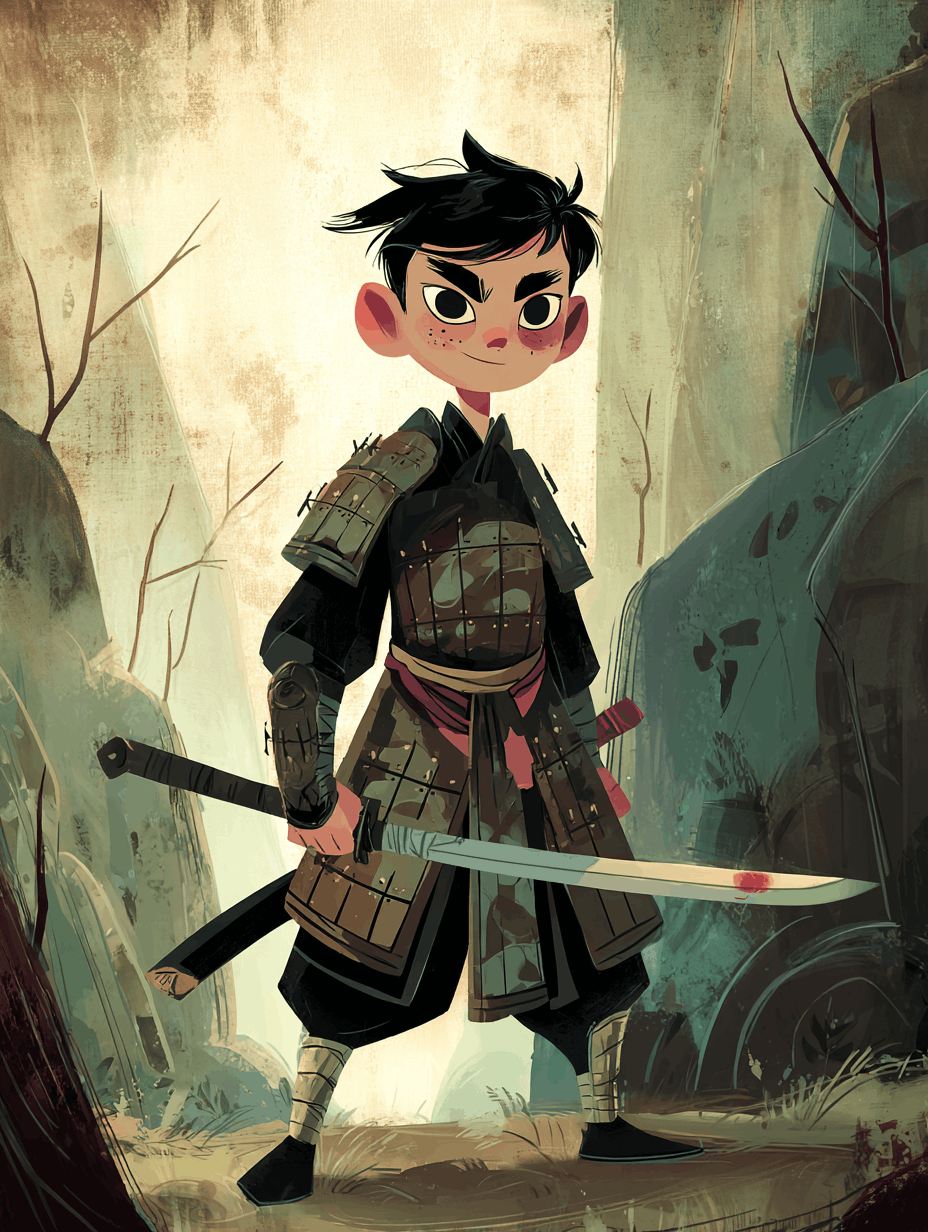
Matsu
(Matsubokkuri — Pinecone)A fifteen-year-old whose silence is so deliberate that when he finally speaks, it either steadies the room or splits it.
What they want
To find his father, who went into the bamboo forest to protect the village before Matsu could follow and never came out. The adventure is real, and he cares about what the team is doing, but he joined because he scanned the faces of the freed men at the end of episode three and his father wasn't there.
What they need
To understand that the version of himself he built after his father disappeared is not the only one available. The silence is his own, built after the loss rather than inherited, and the season keeps asking whether it's actually protecting anyone.
Voice
Speaks rarely enough that each word carries more weight than he intends, which is why the one time he says something unguarded costs him the most. Nobody expects the voice that comes out of him when he sings.
The arc
Matsu enters the season already trying to stop a fight he knows is a mistake, catching Kabu and Kabocha at the edge of Shugoro's bamboo grove to warn them off charging in blind. They don't listen, and it costs the whole village: the fight seals the only road out behind them. Later, alone with his father's real sword for the first time since his father disappeared into that same grove, he tests it on a single bamboo stalk, then a bundle, and the blade snaps trying to finish the second cut. Kabu and Kabocha are both there when it happens, and for once nobody takes the idea and runs with it alone; all three land on what it means together. When the village finally turns on the elder who's kept it silent for years, Matsu is the one who breaks first, needled by a father he still hasn't found: "What about my dad?" The answer that comes back is worse than the silence he's been keeping all episode, so he sings instead, the first time all season anyone's heard his voice, and it's what actually moves the village. When the bamboo demon falls and the freed men stumble out of the thickets, he scans every face. His father isn't there. He catches up with the team at the edge of the clearing anyway, armor clanking, invited along with a joke about his own name rather than asked with a speech. What he brings across the season is practical and often unannounced: he reads situations by watching until the shape becomes clear, and he is the person who names the thing everyone else has walked past. When a mission in episode four ends with Kabocha arguing the ends justified the means and Kabu staying silent, it's Matsu who asks whether they did the right thing. Neither of them answers.
He comes into episode eight siding with tradition and discipline, which is the side that feels most like his father and least like grief. Watching Hiroaki pay the full cost of keeping himself split in two shifts something in him: freedom and self-expression can do things that silence can't. He arrives at episode nine with that understanding still new enough to misfire. At a Tanabata festival where every action is either lucky or unlucky, he gets cornered into a ceremonial moment the room reads as a lucky omen, and the careful guard he keeps around his own words slips: he stammers that if he were ever to marry it would be with someone like Kabocha. He doesn't mean to say it out loud. She quietly leaves the room. Later in the same episode, the demon fight tips into a real eruption between Kabocha and Kabu, and this time Matsu does exactly what episode eight told him to: he steps forward, chooses his words, says what he means, tells her how much she matters to all of them. It's the right thing. It doesn't reach her. She's past the point where the right words could, and she storms out. He does what the episode needs from him after that, but in the quiet moments he's further back inside himself than he's been all season, asking less, naming less. The one exception is a song he sings to Ume in episode ten, a patient argument that you can't force truth into someone who isn't ready, which is about her situation and also, unmistakably, about his own. The season ends with the team back together, and both what he said by accident and what he said on purpose sit unacknowledged alongside everything else that didn't resolve. His father is still missing. The armor still doesn't quite fit.
Relationships
Kabocha
They're the most naturally aligned pair on the team: both fighters who'd rather act than deliberate. But they disagree on when to move in a way that tends to matter, a difference that shows itself for the first time in Shugoro, when she pushes to spring the trap before the village has even been told the plan and turns out to be right. She'll commit before the picture is full because waiting sometimes means it's already too late; he holds until he can see the whole thing, which she reads as hesitation when she's in a hurry. The dynamic is useful right up until episode nine, when he says the thing he wasn't ready to say in a room full of people. She leaves. He makes the calls she would have made. By the end of the season what he said hasn't been named, hasn't been resolved, and sits between them alongside everything else the team didn't finish.
Kabu
Kabu arrived wanting to compete with everything the folk hero template says a hero should look like. Matsu mostly didn't notice. What they trade quietly across the season: Kabu learns to sit with discomfort instead of talking through it, Matsu learns that sitting with something too long sometimes means the moment goes past. By the finale they've become more useful to each other than either of them would have predicted in episode three.
Ume
She talks more than anyone else on the team and thinks out loud in ways that would exhaust someone with less patience. He happens to have exactly that much. In episode nine, his careful attempt to follow the town's contradictory superstitions one by one, each rule tripping him into the next unlucky act, is the funniest he is all season, and she is the only one paying close enough attention to fully enjoy it. In episode ten, he sings to her directly: a patient argument that you can't force truth into people who aren't ready for it. She listens. It's one of the few times she does.
Songs by Matsu
3 songs across the season
Stand Up, Stand Tall
Les Misérables, musical, Revolutionary anthem, slow build, harmonies, triumphant brass, horns, inspiring
12 · Episode 6A Taste of Rivalry
animated musical, ensemble cast, playful, upbeat, theatrical, comedic, storytelling, orchestral, lively percussion, plucked strings, dynamic energy, whimsical, lighthearted, rhythmic, cinematic
19 · Episode 10A Gentle Path
animated musical, koto, shakuhachi flute, soft taiko drums, light strings, steady rhythm, flowing melody
Episodes Featuring Matsu
10 episodes across the season
The Bamboo that Bends
Shugoro · Himeji
The Steep Price of Tea
Cha-Obe · Kobe
Cut to the Core
Usokashi · Aomori Prefecture
Battle of the Bowls
Menpaku · Morioka
The Cost of Comparison
Aokusa · Okayama Prefecture
Beneath the Painted Smile
Futamen · Fukuoka / Hakata
Star-Crossed and Sideways
Aiseki · Sendai
The Fire Beneath the Lake
Shinkami · Hakone
The Fruit of Old Truths
Furumi · Nagano Prefecture — the journey full circle
Those Who Know Cannot Return
Mount Madarao · Mt. Madarao